The Architecture of the Apex: Performing Intimacy in a Man’s World
In the classical myth, the Underworld is a place of absolute finality, a quiet kingdom of shadows where souls are stripped of their earthly titles. In the modern world, my Underworld was a concrete garage.
It sat beneath the heavy, manicured hierarchies of a school, a literal subterranean vault where the cell phone service died, and the air smelled of exhaust and thankless labor. It was left to the Teacher’s Assistants—the lowest rung of the institutional ladder—to handle the grueling, invisible work of carting children to their cars.
It was a place designed for compliance, but I wanted it to be an egalitarian sanctuary. Every day, I brought my whole heart and my full chest down into the dark. I made playlists. I carted a speaker down into the concrete belly so that a thankless job could have a soundtrack. I was in charge of the schedule; he was in charge of the people I assigned to it. Together, we ran the underground.
To work with him there was an intoxicating, emotionally charged harmony. When a major crisis ruptured our ecosystem—a Teacher’s Assistant collapsing under the crushing weight of suicidal ideation—we did the terrifying, fleshy work of an emergency house call.
We split the labor, but we split it along ancient fault lines. He sat on the phone, managing the high-tension, administrative networks of social workers and proper channels. I sat on the floor. I sat with the human being. I made him laugh; I made him think about big things because he was a big thinker like me. I held the weight of his world in the dark while my Orpheus orchestrated the rescue from the threshold.
But our connection never recovered from that night. True intimacy requires face-to-face accountability in the unpolished dark, and Orpheus is a creature who can only exist if he is managing his own orbit.
The Three-Way Panopticon
To understand why the harmony collapsed, one must look at the psychological architecture of the performer. We are taught that Orpheus looked back at the threshold of life out of doubt or clumsy, desperate love.
But the modern Orpheus looks back for a much more devastating reason: he is playing to the balcony.
The tragedy of this dynamic—and the collective problem driving the modern male loneliness epidemic—is best mapped as a rigid, three-way panopticon:
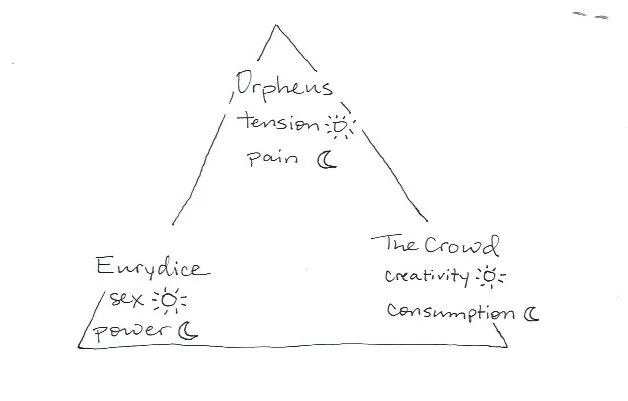
Orpheus sits at the Top Peak, operating entirely in the realm of Tension and public brilliance. On the bottom left sits Eurydice, offering the Light of true intimacy and mutual connection. On the bottom right sits The Crowd—the adoring audience.
The fracture lies in the split gaze. Eurydice is looking up at Orpheus. The Crowd is looking up at Orpheus. But Orpheus’s head is permanently swiveled toward the Crowd. He does not want to be a partner in the quiet, unglamorous shadows; he wants to be seen being one.
Before the garage, he invited me into all sorts of meetings he was conducting, most being absolutely irrelevant to my job. It felt like flirting, but it was actually a public staging of his intuition. When the projector flashed a clip art image of a witch for an icebreaker, I mentioned I felt like a witch in my past life, and he announced to the entire room, “I chose that cause of you.”
It was a beautiful melody. It sounded like the ultimate confirmation of being seen. But he didn’t tell me that privately. He used his structural power as the one on stage to broadcast his depth to an audience. He used my essence to secure his status in the eyes of the collective. He wanted the Crowd to see him seeing me.
The Self-Made Leash
The danger of a woman who steps into her own light is that she threatens the solo orbit of the performer. When the crisis with the TA passed, I prepared a thoughtful, grounding gift to check up on him.
But my Orpheus blocked me. He claimed it would be “more appropriate” if only he went.
He needed to be the sole hero of the narrative. He could not allow me to step into that light because genuine, face-to-face empathy outshines a managed professional performance. Yet, because he is fundamentally terrified of real pain, he couldn’t handle the follow-up. He didn’t check on the TA. He didn’t deliver the gift. He froze on a leash made entirely by himself. He chose the absolute void of inaction over the vulnerability of doing the quiet work.
When I walked into his office and took that gift back from his desk without asking, the silence between us became absolute. By never bringing it up, he ran the ultimate Orpheus defense mechanism: erasure. If he doesn’t acknowledge my clarity, his illusion of being a deeply intuitive leader remains intact.
When I handed him a heartfelt letter ending our colleague dynamic, his words again sounded like a grand musical movement: it “arrested” him; it “really made him think.” He loved the grief of the story. He loved the concept of a broken bond. But his actions remained entirely unaligned with his words. He went radio silent for an official year.
The Farewell to the Spotlight
Now, a full year later, I am boarding a plane to London for a prestigious one-year program. I am stepping entirely into the Creativity and sunshine of my own life, building a destination that has absolutely nothing to do with his orbit.
When I reached out, his response was the classic, lingering melody of the compulsive yearner: “The school is lucky to have you, I’d love to hang out.”
It is a beautiful sentiment, thrown out at the final threshold to keep me retrievable, to ensure that even as I walk away, I am still looking back at him from the shadows. But the text was followed by the familiar, predictable radio silence. No effort. No follow-through.
He cannot make the effort to hang out, because standing next to a woman who is actively stepping into her own light requires him to step down from his apex. He would rather look back, lose me, and spend another year wallowing in his beautiful, tragic solitude, playing his sad songs to an adoring audience who asks for nothing real in return.
At the threshold of the concrete garage, all that is left to say is Farewell. It is not a scream of rage; it is a quiet, devastating release. I would rather be a sovereign soul moving forward into the brilliant, unknown light of my own future, than return to the underground just to be a prop in his spotlight.