Slouching Under Bethlehem
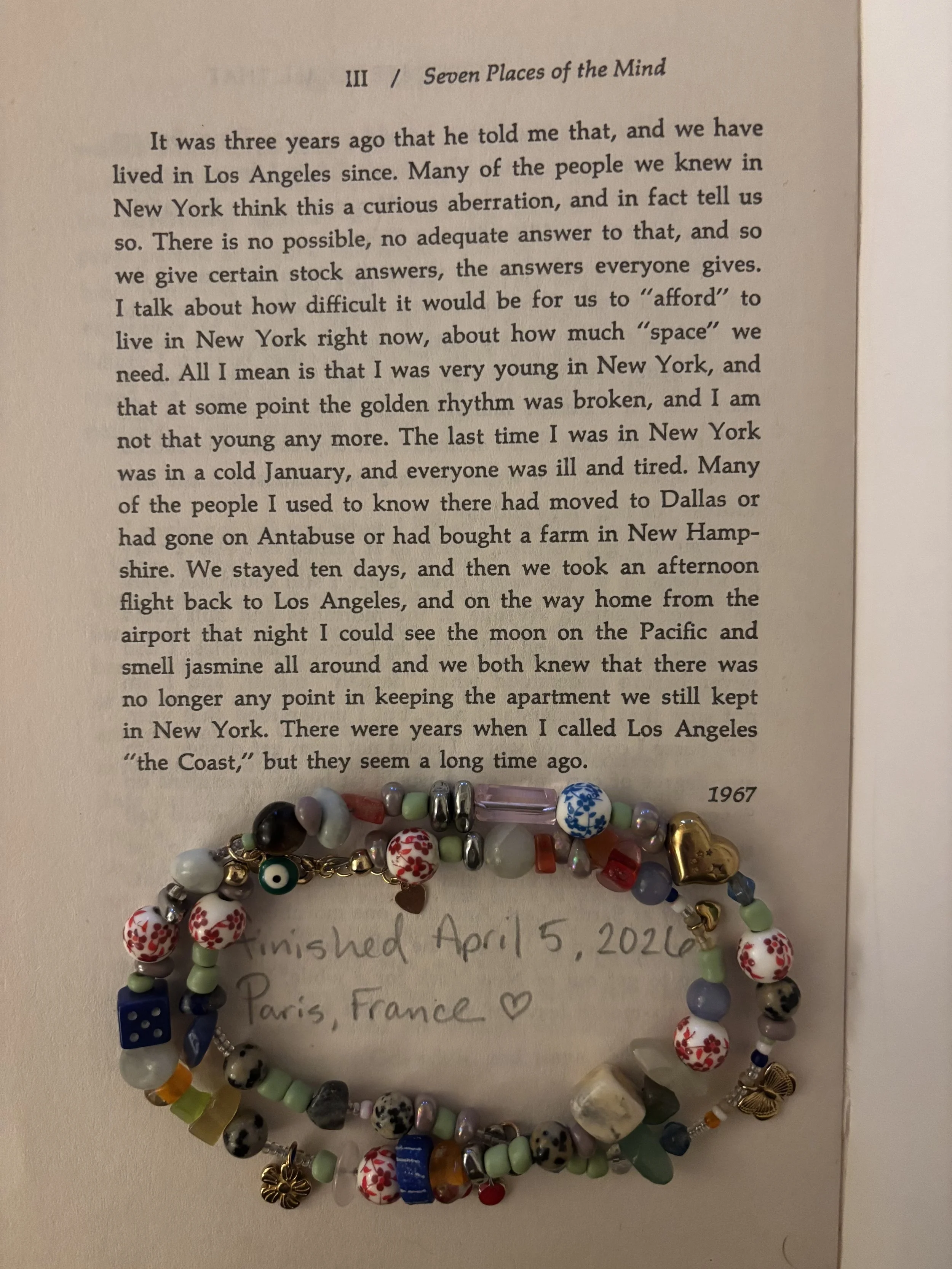
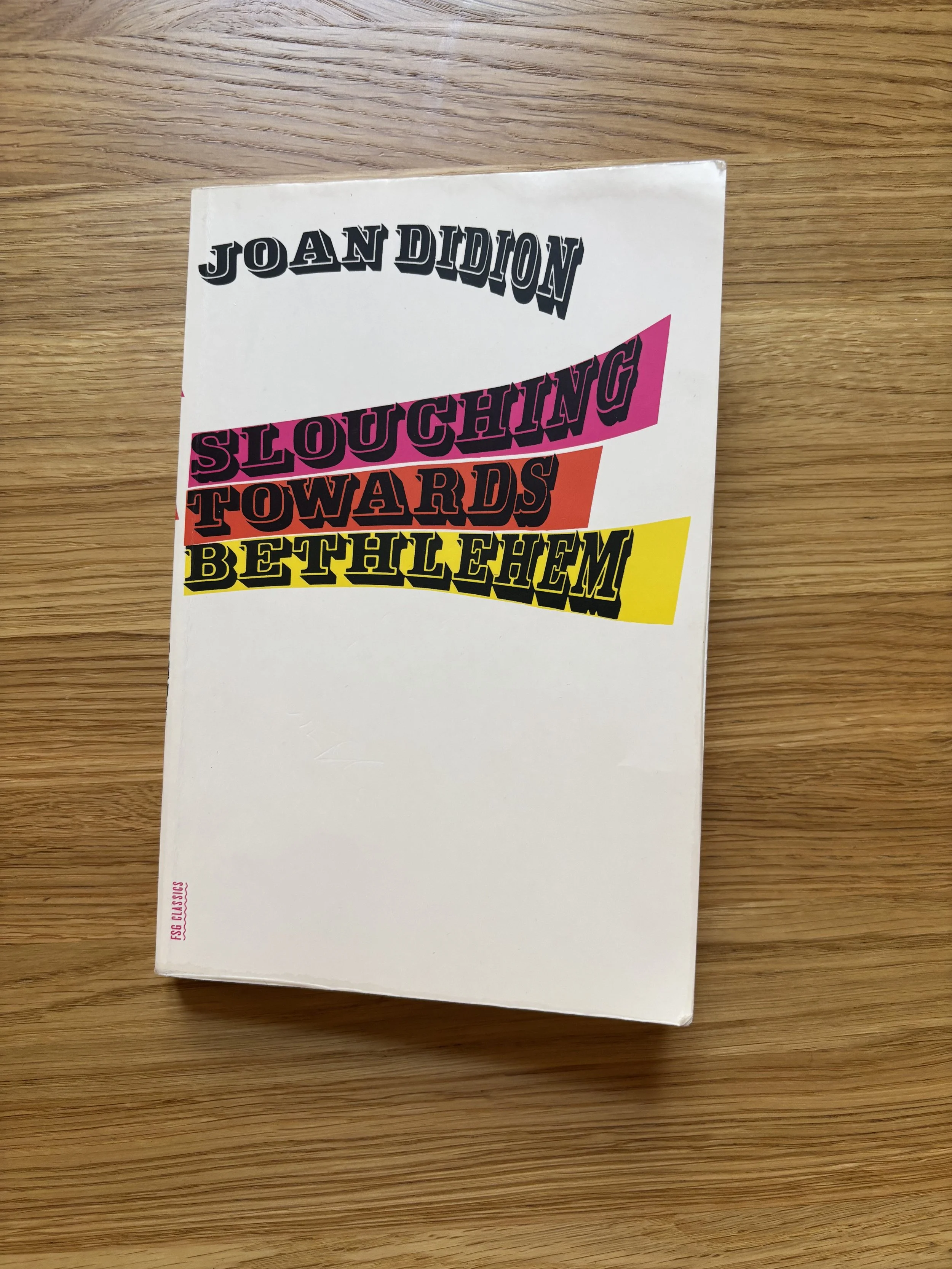
I finished Joan Didion's Slouching Toward Bethlehem on my last morning in Paris, in a café, over an espresso I made last as long as I could. I had been carrying it through four weeks in France the way you carry something you're not ready to be done with — slowly, deliberately, rationing the pages. Didion doesn't write about Paris. But she was with me anyway. That's what happens when you read someone with enough presence. They start keeping you company in rooms they never entered.
I had spent the afternoon before at the Matisse exhibit — the last decade of his life, the cut-outs, the color, the radical simplicity of a man who had earned the right to stop explaining himself. I walked through slowly. I came out speaking a little Matisse. Somewhere between the canvases I became convinced he had told me something — that he knew how to paint an orange orange, but that he wanted to paint it blue. That the truest version of a thing is not always its most accurate rendering. I have since gone looking for that quote and cannot find it. He never said it, or if he did it wasn't written down, or perhaps he said it only to me, in the frequency of the work itself, as I moved through the last decade of his life on a cold bright Paris afternoon. What he did say was this — exactitude is not truth — and maybe that's close enough. Maybe the distance between what he said and what I needed is exactly the point. Art doesn't give you its meaning. It gives you the frequency. You supply the rest.
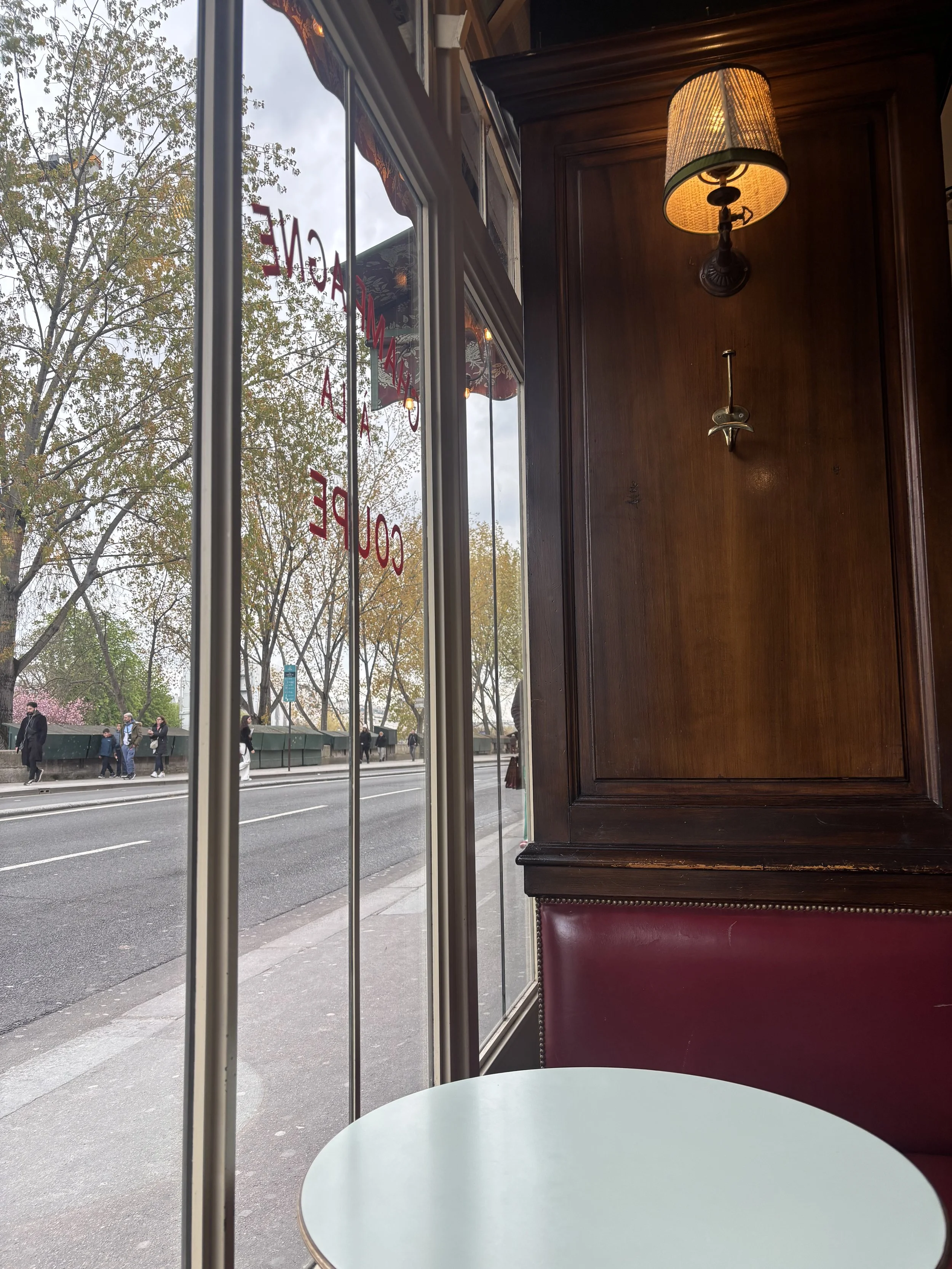
The waiter led me to the sweetest corner booth I'd ever seen. Built into the wood of the bistro like it had always been there, like the wood had grown around it. Room enough for one solo diner or two people in love — no more than that. I had asked for inside. It was one of those Paris days where the cold makes everything bright, the light doing something violent and clarifying to the street outside.
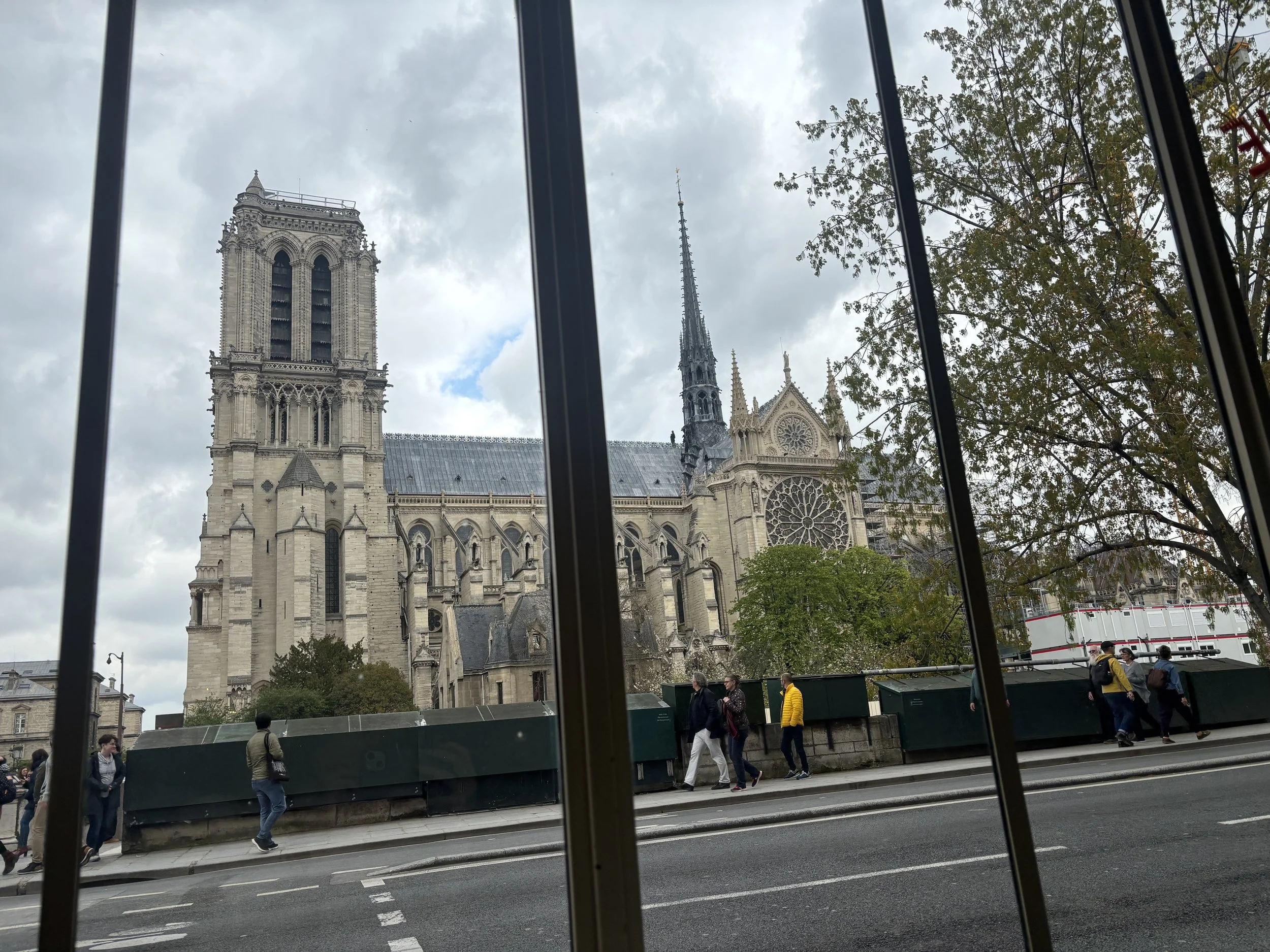
I sat down and there was Notre Dame.
I hadn't gone looking for it. It was just there, the way enormous things sometimes are — patient, rebuilt, asking nothing. Seven years ago it was on fire and the world watched and wept and made the kinds of promises people make when something irreplaceable is visibly dying. And now here it was. Still the view from a corner booth. Still standing inside someone else's ordinary afternoon.
I first let the view feed me while I thought about deals.
Notre Dame burned in 2019 and within seventy-two hours, billionaires had pledged over a billion dollars to rebuild it. The speed of that generosity was its own kind of data point. The cathedral was worth saving. The archive, the architecture, the tourism, the symbol. The deal was easy to make because everyone agreed on the price.
We are always making deals. Some just have the decency to show you what they've decided is worth saving.
In Slouching, Chet Helms told Joan Didion there were only three significant pieces of data in the world in 1967. God was dead and the press had run the obituary. Half the population was or would be under twenty-five. And they had twenty billion irresponsible dollars to spend. He said this over 126 decibels of sound at the Avalon Ballroom while a boy shook a tambourine nearby and high school kids tried to look turned on. Didion wrote it down without comment. That's how you know it was important.
I read that paragraph in a Paris café almost sixty years later and said damn out loud to no one.
Because I know where the twenty billion went.
It went to Reagan. It went to the promise that if you let the money pool at the top, it would eventually find its way down to you. Just keep your mouth open and wait. The hippies who had twenty billion irresponsible dollars to spend in 1967 were in their forties by 1980, and some of them had done the math. The ones who sold out went into finance. Into sales. Into the machinery of the very system they had said they were dismantling. The ones who didn't sell out became the congregation. The crowd at the concert. The audience for someone else's vision. They went from wanting to build something new to consuming someone else's version of the dream they used to have.
The machine was very good at making that transition feel like maturity.
Which is maybe why I'm sitting in a Paris corner booth at thirty-seven, having just said yes to a life I couldn't have predicted, watching Notre Dame hold its ground across the street, thinking about what survives the reckoning.
Not every deal gets honored. But things get rebuilt anyway.
Didion wrote in 1967 that what she was watching in Haight-Ashbury wasn't a movement or a revolution. It was a handful of children, pathetically unequipped, trying to build a community where none had ever existed. She didn't mean it as an insult. She meant it as a diagnosis. The children weren't stupid or broken. They were unequipped because no one had handed them the equipment. The community they were trying to build had never existed for them to inherit. They were making it up in real time, badly, beautifully, with whatever was available, which happened to include a lot of psychedelics and a mafia that had noticed there was money in the hunger.
The mafia is always the first to notice the hunger.
Sixty years later the social vacuum is bigger and the children are younger and the hunger is the same and we call them chronically online and mean it as an insult when actually it's the same diagnosis. They are building community in the only spaces available to them because the physical ones are gone. The church is gone. The union hall is gone. The third space is gone. The neighborhood is gone. They are in Discord servers and comment sections and group chats trying to make something that holds, something that feels like belonging, and we watch and shake our heads at the tambourine.
Meanwhile someone is always packaging the hunger and selling it back.
The latest packaging came in two flavors. One said submit and be protected. One said hustle and be respected. Trad Wife or Girlboss. Pick your coin flip. Both options arrived with aesthetics and influencers and a clean brand identity and neither one asked what you actually wanted or built the structures that would let you have it. They were two sides of the same deal — your hunger in exchange for an identity that someone else designed.
Didion watched the same mechanism in 1967. A woman named Barbara told her about the women's trip and Didion found herself thinking about Betty Friedan and the way people can spend their whole lives carrying values they would never consciously claim as their own. The gap between what we believe we're doing and what we're actually doing. She kept that observation to herself.
I am not keeping it to myself.
Because we are done with false promises. Not because we are cynical but because we are fast. The news cycle moves so quickly now that the gap between the manipulation and the recognition of the manipulation is shrinking. The Trad Wife grift got called out in real time. The Girlboss myth collapsed publicly and we watched and named what happened. We are getting smarter faster. Each generation of unequipped children figures it out a little sooner than the last.
This is not nothing. This is actually everything.
The significant data point of our moment isn't God is dead or half the population is under twenty-five. It's that discernment is now the radical act. In a world engineered for volume, for outrage, for the next thing and the next thing, the ability to see clearly — to know what's real, what matters, what deserves your energy and what is just noise designed to exhaust you — that is power. Not information. Not access. Not followers.
Discernment.
I think about Emerald Fennell making Wuthering Heights.
She has said she first read it as a teenager and misread it. Took it for a love story. Felt it in her body before her brain had the critical apparatus to correctly categorize it. And then she made a film from that misreading. From the blue orange of it. From what it felt like to be a teenage girl alone with that book and all that feeling and no framework yet for what to do with it.
The critics said she got it wrong.
Emily Brontë is not rolling in her grave. She is dead. The book still exists in all its integrity. Fennell did nothing to it. She just painted the orange blue.
This and that are true.
This is the thing the congregation cannot hold. The both/and. The orange that is also blue. The love story that is also a horror story. The hippies who were also children. The deal that was also a theft. The cathedral that burned and was also rebuilt. The country you love that is also the country making you a threat signal in places you're standing.
I am an American woman in Paris in 2026 watching my country become a red level warning on a national park sign and I do not know what to call that either. I am flying home tomorrow on a direct flight — not through Atlanta, not through JFK — because I am alone and it is my period and the airports feel like a place where the deal could go wrong in a new way any given Tuesday and I am done pretending that is an unreasonable fear.
Discernment is just the body knowing before the brain has words for it.
The unequipped children knew something. The teenage girl alone with Wuthering Heights knew something. The woman in the corner booth watching Notre Dame knew something.
We are always knowing things before we have permission to say them out loud.
And when we can't say them, we go looking for somewhere to put the feeling. We go looking for belonging. We go looking for someone to hand us the words.
The hippies became the audience. The Boomers became the market. The Millennials became the workforce that was supposed to be grateful for the privilege of keeping the machine running. And Generation Z is inheriting a social vacuum so complete that they are building community in their phones because there is nowhere else to go.
We keep consuming someone else's vision of belonging instead of building our own.
I have been thinking for a long time about a telephone booth. A vintage one, the kind that used to exist on street corners before we put the whole world in our pockets and somehow ended up more alone. In my version it sits in a market, somewhere people already gather, and you step inside and you pick up the receiver and you hear a stranger's voice. A message they left. Something true they needed to say out loud to no one and everyone. And when you're done listening you leave one of your own.
I call it the Reverie.
It is a small and impractical idea. It is also the only answer I have to the congregation problem. Not a brand. Not a product. Not a packaged identity or a coin flip between two options someone else designed. Just a space where a person can be witnessed. Where the deal is simply — you bring your truth and you receive someone else's. No mafia. No market. No twenty billion irresponsible dollars finding somewhere to go.
Just the telephone. Just the voice. Just the ancient and radical act of one human being saying I was here and another saying I heard you.
This is what doesn't get commodified easily. Not because it's protected but because it's too human. Too slow. Too specific. The machine needs scale and this refuses scale. It insists on the single person in the booth. The corner built for one solo diner or two people in love.
The Reverie is not a new idea. It is the oldest idea. It is what the Haight-Ashbury children were actually trying to build before the mafia noticed the hunger. It is what every generation of unequipped children has been reaching for in whatever spaces were available to them. It is Notre Dame, which is to say it burns and gets rebuilt and burns and gets rebuilt because something in us cannot stop believing it is worth having.
I don't know yet what shape it will take. I am thirty-seven years old and I have just said yes to a life I couldn't have predicted and I am sitting in a corner booth in Paris watching something ancient hold its ground across the street and I am learning to carry more weight without knowing the shape of what I'm carrying.
What I know is this — the orange can be blue. The misreading can be the truest reading. The unequipped child in the corner booth can be the one who figures something out.
Matisse didn't say what I needed him to say. He said something close and I supplied the rest. That's not a failure of accuracy. I think that’s how things work.
Exactitude is not truth.
Both is the congregation's verdict on the blue orange. Both is the coin flip between two identities someone else designed. Both is the story that the money was never there.
Both. And both. And both again. Notre Dame is still in the window.